Yikes! Everyone Looks Like Me!
Over the last half century SJC evolved, accomplishing much more than simply fostering nascent romances, yet it remains a monument to the survival of a stiff-necked people. None of what became its “secret sauce” was the product of a curriculum committee or a strategic plan. It developed organically, summer by summer, initially by immigrant mothers, and eventually by their children (who in due course took over the reins of SJC) led by their instincts, needs and experiences. What emerged, somewhat by accident, is a remarkably effective formula for positive KA identity-building. Our recipe incorporates three essential ingredients—all locally grown, heirloom quality and tinged with a faintly-familiar spicy/garlicky fragrance.
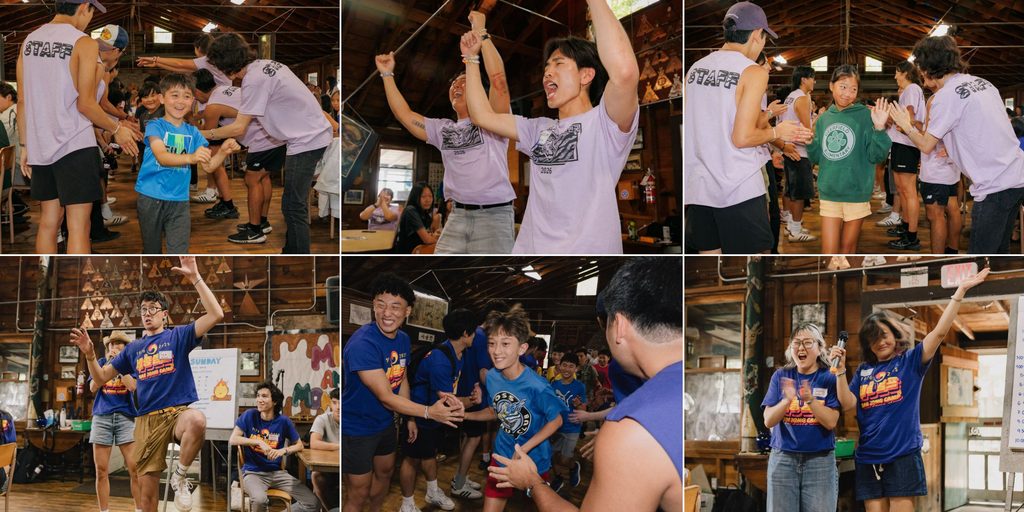
First, and most fundamentally, SJC provides young KAs (who spend fifty-one weeks of the year living as a conspicuous minority) a unique sanctuary wherein they are the overwhelming majority for one full, glorious week. Camp creates an environment where you cannot escape being confronted by people who—for better or worse—look suspiciously similar. For many first-time campers, this is an abrupt, unsettling shock to the system. They arrive from predominantly white neighborhoods where Asian faces are scarce, and being “different” is too often a source of schoolyard ridicule. To be suddenly thrust into a hundred-plus crowd of peers who mirror one’s physicality can initially feel uncomfortable, both corporeally and emotionally. (SJC 2026 topped 110.) One of my generation might even say this experience is dis-orienting—only to be advised that this antiquated term has been replaced by the more modern, less cringeworthy, and more geographically accurate term “Asian.” It is not uncommon for a new SJC camper to spend their first few hours desperately wanting to pack their bags and go home. Over the years I have personally fielded more than a few plaintive phone calls from parents relaying just such a plea for immediate extraction. Not one of those campers ever actually left early. Moreover, not one of them regretted staying.
This is due in large part to the energetic pace of camp, which leaves precious little time to dwell on existential discomfort. Surprisingly soon, instead of seeing a sea of reminders of hometown humiliation, campers begin identifying each other by their eccentricities: the guy who sang the ridiculous song at opening campfire, the girl who has NO inside voice, or the impossibly hot (매워요) camper who smiled directly at you across the camp green. Everywhere you turn, dark eyes and dark hair. Plenty of cuties to get to know, but nary a blonde head or blue eye in sight. Within forty-eight hours, the “sameness” that felt so foreign and uncomfortable on Day One has quietly dissolved into the ordinary, granular business of identifying people as individuals—not what they look like—which is to say, into normal childhood. Nobody argues a child out of feeling like an outsider. You simply put them somewhere the feeling becomes irrelevant, and let the week do the rest.
Academics call this visceral realization “validation.” Seeing yourself echoed in countless ways across a community subconsciously affirms that you are not alone, you are not an oddity, rather you belong to a larger, heretofore unseen collective. Campers and staff provide gut level, tacit confirmation that we are part of a much greater whole. This shift in self-image carries immense power for any child, and can be a literal lifeline for adopted Korean children, raised by white parents, growing up in rural or suburban areas largely devoid of Asians. For many KAs, this profound sense of normalization doesn’t hit until college; at SJC, it becomes real as early as age seven. I’ve watched this happen in real time—a junior camper, a few days in, catching sight of their own reflection doing a small double-take, as if noticing for the first time that they belong to a larger tribe. It is a small miracle, but it happens every summer, usually unacknowledged by the child experiencing it—yet powerful and often life-changing.
Second, SJC constructs a living ladder of role models for the extended family it creates. In many ways camp is a “human smorgasbord”: a wonderful assortment of ages, body types, facial features, personalities, fashion sense and familiarity with personal hygiene. Campers can observe and emulate qualities of their peers and elders. Just like life back home, they do this both intentionally and unconsciously. Being “cool” is great, but being comfortable in your own skin is even better. Grade-schoolers look up to high-schoolers; middle-schoolers mimic the college-aged counselors. Campers notice EVERYTHING. The way counselors walk, the words they use, how they brush their teeth, and the way they pick their butts. Thus forewarned, staff are hopefully more circumspect about their conduct—having small, observant shadows surrounding them brings out their better angels. Campers get a tangible preview of who they might become later in life—both physically and in disposition. They realize they can be just as popular and confident as the somewhat portly but wonderfully funny counselor, or as intimidating as the potentially lethal, twentyish commandant—artfully disguised as a five-foot-three female program director. Convincing evidence that commanding and capable leadership is a hereditary trait inherent in Korean women regardless of stature—a self-evident truth, well-known to anyone married to these beguiling alpha-females. (Such knowledge is not infrequently acquired via naive misadventure on the non-distaff side.) SJC has been very fortunate: day-to-day leadership over the past ten years has been ably handled, in succession, by two talented diminutive young KA women, both of whom have proven outstanding role models to campers and staff of every gender — bringing warmth, emotional intelligence, wisdom, and quiet effectiveness to their posts. At SJC, there has never been a ceiling for women to break.
For adopted campers, these role models silently answer heavy, unasked questions that loving non-Korean parents are rarely equipped to address: What will I look like as a teenager? How can I style my hair? Will I ever be considered attractive? What does a well-adjusted Korean adult actually look like? Adults easily forget how vital and influential role models are for youth, but experience proves that they will find and imitate role models (good or bad) on their own. SJC puts them among the best.
Third, SJC arms campers with cultural body armor. We explore our heritage and identity through staff presentations, vibrant discussions, craft projects, language classes, cooking Korean dishes, and quasi-nutritious Korean snacks available at the camp store. A spectrum of subtle and blatant techniques is employed to provide the factual knowledge required to ward off the inevitable ignorance of the outside world—whether manifested as being carelessly misidentified or outright racial slurs. Accurate and relevant facts pack the self-esteem of our SJC community members so full that the casual insults flung our way fail to deflate one’s self-worth. For example: we learn that our ancestors invented a phonetic alphabet centuries ago that bypassed the limitations of ancient ideographs. Clad with this clarity, our kids can more easily dismiss their detractors as merely uneducated when they are maliciously taunted as “Chink” or “Jap,” transforming a painful insult into merely a boorish stranger flaunting their stupidity.
Grand Larceny and the Westminster Statute of Imitations
Of course, cultivating pride and self-worth cannot be done in a vacuum. It requires a functional, sturdy framework to grow in. To create the scaffolding necessary to support the strategy detailed above, SJC has resorted to a generous helping of friendly larceny. Many of SJC’s routines, songs, chants, traditions, and rituals were inspired, if not outright stolen, from Westminster Camp (WC). Undeniably, this was because I happily spent much of my own youth as a WC camper and staffer. Technically, the statute of imitations for said intellectual plagiarism has long since passed. Fortunately, at this late date, the cultural property assiduously hijacked from WC has become so integrated into SJC’s DNA that many on both sides believe it to be Korean in nature. The author defies the reader to identify the origins of the following SJC practices.
Doing your bit as part of the community is woven into SJC as every camper rotates through “waiter” duties (setting tables, serving food, clearing tables, and floor sweeping) on given days. Likewise, rotating camp-wide clean-up chores are given daily to each cabin (determined by age and gender) as “capers”—to be done along with individual cabin tidying up after breakfast. More than a few parents have remarked with incredulity that their children willingly do this at SJC, but are totally incapable of similar domestic feats once home. There is also a “No Devices” (i.e., cell phones, tablets, pads, etc.) rule for campers spelled out in the literature, reiterated at the first camp-wide meeting, and enforced by seizure of said contraband if discovered at camp (but returned after). Again, many parents marvel that their kids can go “screen-free,” cold-turkey, for an entire week and praise SJC for this imposed abstinence.
One rare-ish SJC staple not pilfered or purloined from WC is the “tunnel.” Shortly after all campers (and an intrepid group of curious parents) gather in the dining hall for the first time at the very start of camp, staff form two parallel lines extending their arms and hands inward forming a “tunnel.” Each one is introduced with a memorable, audacious, and occasionally true backstory or questionable inside joke, after which they race through the tunnel to laughter and cheers. By the time all staff have been thus celebrated the energy and volume in the cavernous, venerable chamber is palpable. At this emotional acme campers are called up one by one, dash through the boisterous tunnel, trading high-fives and hand-slaps, and are assigned to their cabins—starting with the youngest. Uninitiated, first-time campers quickly grasp the proceedings, joining in with gusto. They emerge from the tunnel with broad smiles, feeling like rock stars.
[To be continued]
Doug Kim
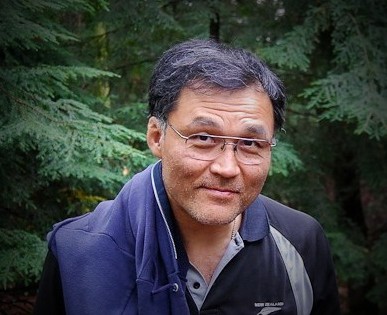
Now retired, Doug has spent over 30 years as a steady presence at Sae Jong Camp, serving as a counselor, staff trainer, and Director. Carrying forward the work his mother helped begin, he helped forge the core Korean American traditions, cultural pride, and lifelong bonds that continue to define our shared legacy across generations.